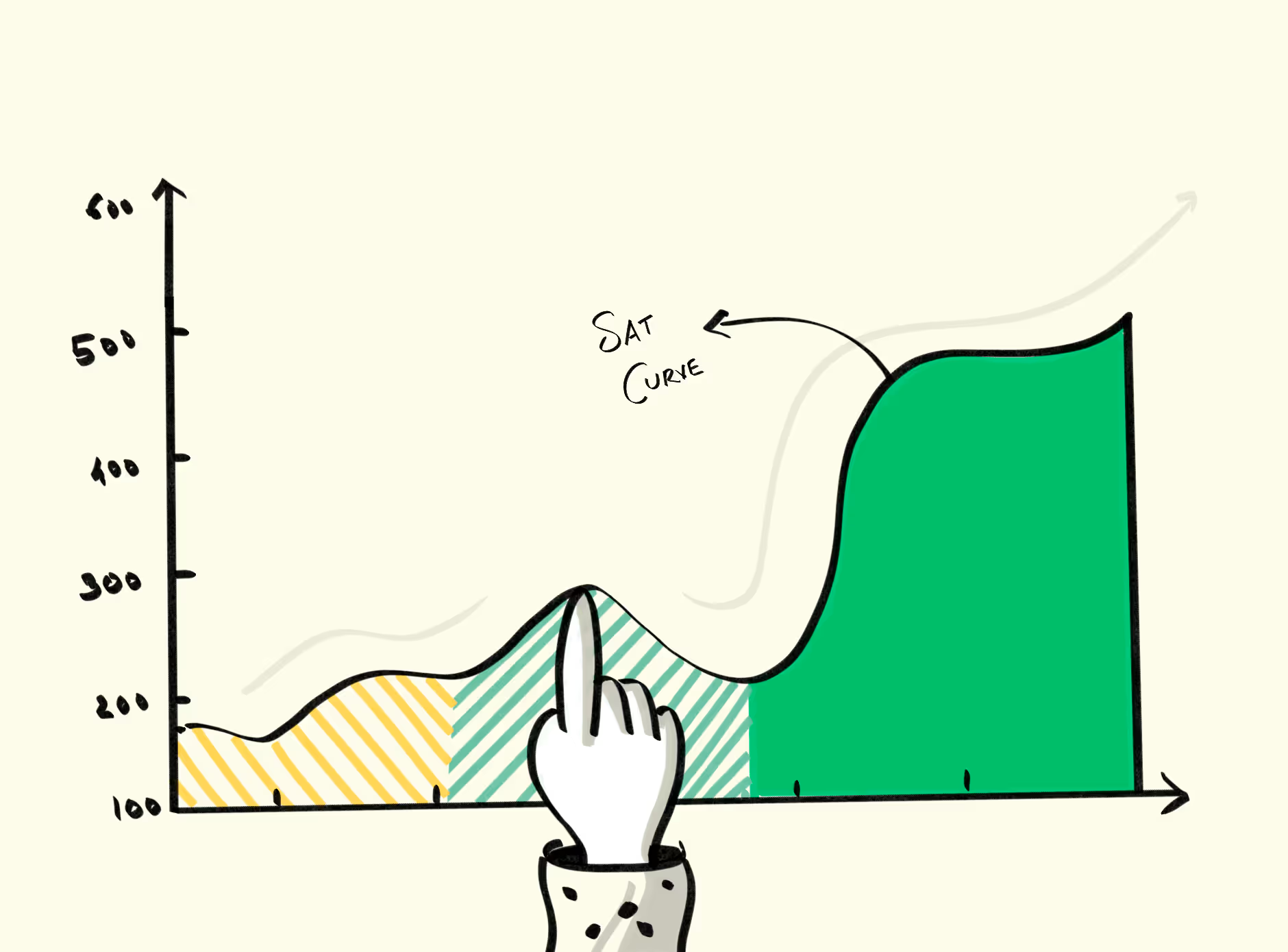
The SAT isn't curved, it's equated. The College Board uses a statistical process where your score depends on the specific difficulty of the questions you receive, not how other students perform on your test date.
- Independent scoring — Your grade is never raised or lowered based on your test room or peer group's performance.
- Pre-determined adjustments — Question difficulty levels and point weights are pre-tested and set before test day, not adjusted afterward.
- Consistent scale — A given scaled score, like a 1400, represents the exact same academic skill level regardless of which test edition you take.
- Multi-stage adaptive design — The digital format splits sections into two modules, where Module 1 performance determines Module 2's difficulty.
- Question weighting — Correct answers on harder modules carry more weight, so missing a hard question costs less than missing an easy one.
- No guessing penalty — Wrong answers simply score zero rather than subtracting points, so leaving a question blank offers no advantage.
No, the Digital SAT is not graded on a curve. The College Board uses equating, a statistical process that accounts for differences in test difficulty across different SAT administrations. This means your score isn't based on how other students performed on the same test.
Equating is often confused with a curve because a student's raw performance can translate to a slightly different scaled score depending on the difficulty of the test form. The Digital SAT is also adaptive, so your performance in Module 1 determines whether you receive a harder or easier Module 2, which affects your scoring potential.
In this guide, you'll learn:
- How Digital SAT scoring works
- What equating means and why it isn't the same as curving
- How adaptive modules affect your score
- Whether a harder or easier test can change your final score
- Common Digital SAT curve myths and what the College Board actually does
Is the SAT Graded on a Curve?
No. The Digital SAT is not curved.
Instead, the College Board uses equating to account for differences in difficulty between test forms.
How SAT Scoring Actually Works
- A traditional curve compares you with other test-takers. If a class performs poorly, a teacher might adjust grades upward. Your grade depends partly on how others perform.
- The SAT does not work this way. Your score does not depend on how other students perform on the same test.
- The College Board uses equating. This statistical process accounts for differences in difficulty between SAT test forms.
- A harder test can have a different raw-to-scaled score conversion. If your test form is harder, you may be able to miss more questions and still earn the same scaled score as someone who took an easier form.
- Your final score depends on two things: the difficulty of your test form and how you performed on it, not on the performance of other test-takers.
Why Do People Call It an "SAT Curve"?
The confusion usually comes from the conversion between:
Raw score → Number of questions answered correctly
Scaled score → The 200-800 section score reported to colleges
This conversion exists, but it is equating, not curving.
For more detail, see the College Board's official scoring and equating documentation.
What Is the SAT Bell Curve, and Is It the Same as Being Graded on a Curve?
These are two completely different things, and the confusion between them is the single most common myth about SAT scoring.
The SAT bell curve refers to the shape of the distribution when you plot all test-takers’ scores on a graph. Most students cluster around the middle (roughly 1000 to 1100), with fewer students at the very low and very high ends. That bell-shaped distribution is just a statistical description of how scores naturally spread out. It doesn’t mean anyone’s score was adjusted because of it.
Being graded on a curve, on the other hand, is an active adjustment a teacher makes to scores after the fact, based on class performance. The SAT does not do this.
In short: the SAT produces a bell-curve-shaped distribution because students’ abilities naturally fall on a bell curve. But your individual score is set by equating against test difficulty, not by where other test-takers landed.
How Does the Digital SAT Calculate Your Score Without a Curve?
The Digital SAT has two sections: Reading and Writing and Math. Each section contains two adaptive modules, for a total of 98 questions completed in 2 hours and 14 minutes.
How Adaptive Scoring Works
- Module 1 sets the difficulty for Module 2. Your performance in the first module of each section determines whether you receive a harder or easier second module.
- A harder Module 2 is not a penalty. It means your performance in Module 1 qualified you for a more challenging set of questions with greater scoring potential.
- An easier Module 2 does not mean you will receive a bad score. Your final score still reflects your performance across both modules.
- Question difficulty affects scaling. Two students can answer the same number of questions correctly but receive different scores because they encountered different levels of difficulty.
Digital SAT Score Range
- Reading and Writing: 200-800
- Math: 200-800
- Overall SAT score: 400-1600
The Digital SAT does not use a simple raw-score system where every correct answer contributes the same amount to the final score. Its adaptive design and scoring process account for question difficulty when converting performance into a scaled score.
What Is SAT Equating and Why Does It Replace the SAT Curve?
Equating is the statistical process the College Board uses to account for differences in difficulty between SAT test forms. It allows scores from different test dates to be compared fairly.
- What is equating?
It converts raw performance into a standardized scaled score so that the same score reflects a comparable level of ability across different SAT test forms. - Why does the College Board use it?
SAT forms can vary slightly in difficulty. Equating accounts for these differences when converting raw scores into final scaled scores. - Why does fairness matter?
Without equating, students who receive a harder test form could be unfairly disadvantaged, while those who receive an easier form could be rewarded. Equating helps ensure scores reflect ability rather than which test form a student happened to receive. - Why don't colleges compare raw scores?
Raw scores simply reflect the number of questions answered correctly and cannot account for differences in test difficulty. Colleges therefore use the standardized scores reported in the SAT results report when evaluating SAT performance.
In simple terms, equating makes SAT scores comparable across different test forms. It is often called an "SAT curve," but it is not a traditional curve based on how other students perform.
SAT Equating vs. SAT Curve: What's the Difference?
The core difference is simple: a curve compares students with each other, while equating accounts for differences in test difficulty. The SAT uses equating so that students are evaluated consistently across different test forms and test dates, regardless of which version they receive
How Does Equating Work on the Adaptive Digital SAT?
The Digital SAT uses adaptive modules, so your Module 1 performance determines whether you receive a harder or easier Module 2.
(For a full walkthrough of the two-module structure, see our Digital SAT structure breakdown.)
This affects the range of scores available to you.
- Hard Module 2: Students who perform strongly in Module 1 are routed to a harder second module. This path provides access to the full scoring range, including the highest section scores.
- Easy Module 2: Students who perform less strongly in Module 1 receive an easier second module. This path has a lower scoring ceiling, even if the student performs very well in Module 2.
- Why does the harder module allow higher scores? The harder module includes questions that help distinguish between different levels of high performance. This gives the scoring system more information about a student's ability at the top end.
- Why isn't the easier module a punishment? The easier path still measures your performance and contributes to your final score. Its lower ceiling reflects the information available from the questions you received, not a penalty for making mistakes.
EdisonOS's Advanced Scoring Engine replicates these adaptive scoring constraints in its practice tests, giving students a more realistic picture of their potential Digital SAT score.
What Happens to Your Score If You Get a Harder Test?
This is the most common source of test-day anxiety: “What if I get the harder version? Won’t my score be lower?” The short answer is no. Equating is specifically designed to make sure it doesn’t matter.
Here’s a concrete example. Imagine two students, both with the same true ability level:
- Student A is routed to the harder Module 2 and gets 16 out of 22 questions correct.
- Student B is routed to the easier Module 2 and gets 19 out of 22 questions correct.
Student A answered fewer questions correctly, but because the harder module’s questions are weighted more heavily through equating, both students end up with roughly the same scaled score. The harder questions Student A faced “counted for more.”
The flip side: if you get the harder module and miss the same number of questions you would have missed on the easier one, your scaled score will be higher than the easier-path student’s, because the equating model recognizes that your wrong answers came on tougher questions.
This is why obsessing over which Module 2 you’ll get is wasted energy. The scoring is built to be fair across both paths. If you want to model how raw answers translate to scaled scores yourself, try the Digital SAT score calculator.
Does the SAT Curve Change by Test Month?
No. March, October, and December do not offer an easier SAT curve. The College Board uses equating to account for differences in test difficulty across administrations.
- March SAT: No built-in scoring advantage.
- October SAT: No easier curve than other test dates.
- December SAT: Equated using the same principles as other administrations.
- Easier-month myth: A test may feel easier or harder on a particular date, but that does not make the scoring system more favorable.
- Equating removes monthly advantages: Your score reflects your performance and the difficulty of your test form, not the month you take the SAT.
Choose your test date based on when you're best prepared, rather than trying to find an easier curve.
(If you’re also weighing the ACT, our SAT ACT concordance conversion chart helps you compare scores across both tests.)
What Does the SAT Curve Mean for Your Test Preparation?
The single most important takeaway from how equating works: you cannot predict which Module 2 difficulty you’ll see on test day. That means your prep has to account for both paths.
Three things actually move the needle:
1. Practice Both Adaptive Module Paths
Build confidence with both easier and harder Module 2 questions. This helps you stay prepared regardless of which path the test assigns.
2. Use Realistic Adaptive Mock Tests
Practice with full-length tests that replicate the Digital SAT's adaptive format, timing, and module routing. This helps you get comfortable with the experience before test day.
3. Track Progress Using Scaled Scores
Don't rely only on the number of questions you get right. Track your scaled scores over time to measure improvement and see whether your preparation is moving you toward your target score.
Ready to start? Start Free Trial
Frequently Asked Questions
.svg)


.png)

.png)