Practice alone doesn’t raise scores; structured error analysis turns mistakes into measurable improvement.
Categorizing errors reveals whether content, strategy, execution, or interpretation is holding students back.
Consistent error logs and targeted follow-up drive faster, more reliable SAT score gains.
This guide gives SAT and ACT tutors a step-by-step error analysis system with:
The four error types that drive test mistakes
How to build a digital error log that tracks them across practice tests
How to spot pacing patterns
How to turn that data into a targeted study plan
If you’re wondering how to analyze exam mistakes to improve teaching, this guide is for you. You’ll learn to separate your students’ careless errors from conceptual gaps, identify recurring timing issues, and adapt the same error log system for both the digital ACT and SAT prep.
Read on.
What Is an SAT Error Log and Why Every Tutor Needs One
Many students assume that more practice automatically leads to better scores. In reality, improvement comes from deliberate review. In reality, you need a deliberate review of SAT practice test data and score improvement.
SAT error analysis forces students to reflect on their thinking, pacing, and decision-making. This process builds SAT metacognition, the ability to monitor and correct one’s own thought process during a test.
Students who regularly perform SAT mistake analysis improve faster than those who only take additional tests. Tutors who prioritize SAT wrong answer review help students reduce repeat errors, develop confidence, and gain control over the exam rather than feeling rushed or reactive.
The Four Types of SAT Mistakes (And Why They Need Different Fixes)
Not all mistakes should be fixed the same way. Without categorization, you risk reteaching content when the real issue is strategy or execution.
Understanding error types allows you to apply the right intervention and avoid wasted effort.
Not all mistakes have the same solutions. Without proper categorization, you’ll keep reteaching the same content when the real issue is pacing, question interpretation, or execution.
A strong SAT mistake log helps identify what students missed, but it also tells you why they missed it. Understanding error types will help you apply the right intervention without wasting effort.
1. Time Issues
Time issues occur when students know how to solve questions but cannot complete the section efficiently under test conditions. These errors are often caused by pacing breakdowns, inefficient solving methods, or spending too long on difficult questions.
How this shows up on the SAT:
Leaving the last few questions blank in a module
Rushing through final Reading & Writing questions with low accuracy
Spending 3 to 4 minutes on a single difficult Math question
Accuracy drops sharply toward the end of a section
How to identify this:
Errors cluster near the end of the module
The student understands the content during review, yet they frequently say they “ran out of time”
They show significantly better accuracy in untimed attempts
Ways to address it:
Teach skip-and-return strategies
Set pacing benchmarks for each section
Review alternative solving methods for efficiency
Run timed section drills instead of untimed repetition
Analyze the time spent per question during the SAT wrong answer review
Do not reteach content if the student already knows it but cannot complete the section in time. Time issues are pacing problems first, not knowledge problems.
2. Comprehension Issues
Comprehension issues happen when students misunderstand what the question is asking, even if they know the underlying concept. These errors are especially common in Reading & Writing, where small wording differences change the meaning of the question.
How this shows up on the SAT:
Missing keywords such as “NOT,” “EXCEPT,” or “best supports”
Choosing answers that are true but do not answer the question
Solving for the wrong variable in Math
Confusing supporting details with the main idea
How to identify this:
The student solves a related problem instead of the actual question
The student says, “I thought they were asking something else”
Errors continue even after content review
The work process looks correct, but the final task was misunderstood
Ways to address it:
Ask students to restate the question before solving
Teach annotation habits for task words and qualifiers
Practice predicting answers before reviewing choices
Review why tempting wrong answers feel convincing
Slow students down at interpretation points, not every step
Students with comprehension issues often know more content than their scores suggest. They don’t necessarily need new skill mastery because the problem is task interpretation.
3. Content or Procedural Issues
Content or procedural issues occur when students do not know the concept, rule, or process needed to solve the problem correctly. This is the most direct type of knowledge gap.
How this shows up on the SAT:
Forgetting exponent rules or systems of equations methods
Not recognizing punctuation or grammar rules
Struggling with nonlinear functions or geometry formulas
Confusing transition words such as “however” and “therefore”
How to identify this:
The student cannot explain the rule or concept during review
Retaking the question without time pressure still causes confusion
Similar mistakes appear repeatedly in the SAT error log
The student relies on guessing instead of a defined process
Ways to address it:
Reteach the concept clearly and concisely
Assign targeted drills focused on one skill at a time
Ask students to explain the process in their own words
Track recurring domain tags in the SAT error log
Reassess the same skill in future sessions for retention
This is the only error type that usually requires reteaching. If the issue is conceptual knowledge, pacing drills and strategy adjustments will not solve it.
4. Careless Errors
Careless errors happen when students know both the content and the procedure but make execution mistakes during the test. These are often caused by rushing, fatigue, overconfidence, or inconsistent checking habits.
How this shows up on the SAT:
Arithmetic mistakes in the final calculation step
Bubbling or entering the wrong answer
Skipping words such as “not” or “except”
Copying the wrong number from scratch work
Choosing the wrong answer despite identifying the correct evidence
How to identify this:
The student immediately recognizes the mistake during review
The question is solved correctly on a second attempt
Errors increase under time pressure
The work process is mostly correct, but execution breaks down
Ways to address it:
Require students to show all calculation steps
Build a consistent final-answer checking routine
Teach students to slow down at decision points
Track careless errors separately in the SAT error log
Review patterns in rushed or high-pressure sections
Careless Errors vs. Content Gaps: How to Tell Them Apart
Tutors often confuse careless errors with content gaps, but the intervention for each is completely different.
A content issue means the student still cannot solve the problem correctly during review, even without time pressure. A careless error, on the other hand, means the student recognizes and fixes the mistake almost immediately after revisiting the question.
For example:
A student who forgets how to solve systems of equations has a content gap.
A student who solves the system correctly but copies the wrong value into the answer box made a careless error.
If tutors misclassify careless errors as knowledge gaps, students end up doing unnecessary drills instead of improving execution habits.
The SAT error log should track these categories separately so each mistake leads to the right correction strategy.
How to Build a Digital SAT Error Log: Fields, Tags, and Templates
An SAT error log turns isolated mistakes into a learning system.
Without a log, students rely on memory, which is unreliable and biased. With a log, patterns become visible. You can track which skills repeat, which error types dominate, and whether interventions are working.
The goal of an SAT error log is not record-keeping. It is diagnosis and follow-through.
Your goal is to turn every mistake into data that informs future instruction. A good SAT error log captures not just what went wrong, but why it went wrong and what will change next.
What an SAT error log should include
Your SAT error log should capture both performance data and decision-making patterns. Include these fields for every missed or uncertain question:
Field
What to Record
Example
Test ID & Date
Which practice test and when it was taken, and when
Bluebook Test 3, 2026-04-12
Section
Reading & Writing or Math
Math
Module
Module 1 or Module 2
Module 2
Question Number
Question within the module
Q18
Topic / Domain
Specific SAT skill area
Advanced Math - Nonlinear Functions
Difficulty
Easy / Medium / Hard
Hard
Error Type
Time Issue, Comprehension Issue, Content/Procedural Issue, or Careless Error
Comprehension Issue
Confidence Level
Skipped / Guessed / Thought I Knew
Thought I Knew
Time Spent
Estimated time spent on the question
~3 minutes
Root Cause
Why the mistake happened
Solved for the wrong variable
Resolution Action
What changes before the next test
Practice variable-identification drills
The most effective SAT error logs also use a simple tagging system to make patterns easier to track across tests. A good rule is to keep the system under 20 total tags:
Too many tags create noise. What you want is pattern recognition and not over-documentation.
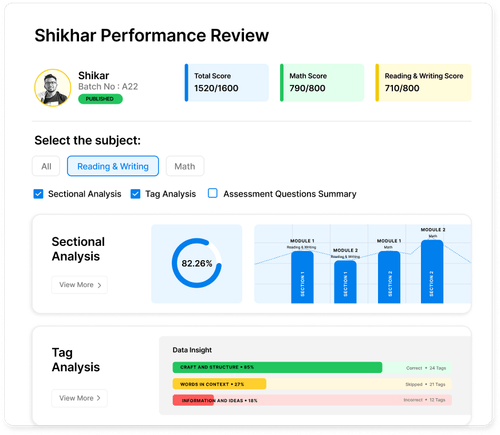
Platforms like EdisonOS already track many of these fields automatically after every practice test, including time spent, skill tags, difficulty level, and accuracy data. That reduces manual logging and allows tutors to focus more on diagnosis and intervention.
How you should use the error log
A strong error log only works if tutors review and act on it consistently. Here are the best practices:
Fill it out together initially to model the process
Gradually shift responsibility to the student
Review the log at the start of every session
Use it to assign targeted practice, not generic homework
Compare logs across multiple tests to identify trend changes
You don’t just want to store mistakes with a SAT error log. It only becomes valuable when it changes instruction decisions.
How to Spot Pacing Errors from the Answer Pattern
Many tutors focus on which questions students missed, but where and when those mistakes appear in a section often matters just as much. Say, for example,
Unanswered questions grouped at the end of the Math Module
Accuracy dropping sharply in the final Reading & Writing questions
Several guessed answers appear consecutively
These are all signals that the student is struggling with timing, decision-making, or using inefficient solving strategies. To help them overcome such mistakes, you need to make them practice digital SAT pacing.
Here, the intervention strategy should focus on improving through timing strategies and section management rather than additional concept review. With EdisonOS, this becomes easier as the platform helps you track time-per-question data, skipped-question patterns, and accuracy trends across multiple practice tests.
Teaching students to identify error patterns
Patterns matter more than individual mistakes.
SAT error patterns reveal where students lose points consistently, often without realizing it. These patterns might involve specific question types, sections, or moments of fatigue.
Teaching students to recognize SAT error patterns builds awareness and self-correction skills. Over time, students begin anticipating mistakes before they happen.
Common patterns appear across:
Question types
Specific skills
Time pressure moments
End-of-test fatigue
Overconfidence in easy questions
Pattern recognition is a core SAT test review strategy and a key outcome of teaching SAT error analysis well.
Section-Specific Error Analysis: Reading & Writing vs. Math
Error analysis must adapt to the demands of each SAT section. A one-size-fits-all approach misses key nuances.
Reading and Writing
Most Reading and Writing errors stem from misinterpretation rather than a lack of grammar knowledge. Students often choose answers that sound reasonable but lack evidence.
Ask students to justify answers using specific text references. Reviewing why wrong options are wrong is often more instructive than confirming the correct choice.
Common issues
Ignoring evidence requirements
Falling for extreme language
Misjudging tone or purpose
Blank-answer clusters near the end of Reading & Writing modules often signal pacing breakdowns caused by over-reading earlier passages or spending too long evaluating similar answer choices.
Focus areas to prioritize
Require evidence-based justification for every answer
Train students to eliminate wrong options explicitly
Review tone, purpose, and question intent carefully
Emphasize why incorrect choices fail the evidence test
On the digital SAT, comprehension issues and time issues are usually more common in Reading & Writing than pure content gaps. And accuracy in Reading & Writing comes from disciplined interpretation, not rushing through passages.
Math
Most Math mistakes come from execution, procedural, or interpretation issues rather than an inability to understand the concept itself.
Common issues
Skipping steps
Misreading word problems
Rushing through easier questions
Again, blank or guessed answers near the end of Math Module 2 often indicate pacing problems caused by spending too much time on difficult questions earlier in the section.
Focus areas to prioritize
Enforce step-by-step written work
Teach students to identify what the question is asking before solving
Compare solution paths for efficiency
Address rushing on easy questions as a priority issue
Careless errors and time issues are especially common in Math, particularly under adaptive-module pressure. Therefore, Math review should reinforce that clarity and process matter more than speed alone.
ACT Error Log: Adapting the System for Four Sections
For ACT prep, an ACT error log uses the same core framework as an SAT error log, but the analysis changes because the ACT separates performance across English, Math, Reading, and Science.
Instead of looking only at total accuracy, tutors should track which section consistently lowers the student’s composite score and which error types repeat within that section.
For example, recurring pacing issues in ACT Math require a different intervention than repeated data-interpretation mistakes in ACT Science
This is especially important because ACT Science errors are often not true content gaps. Many students lose points because they misread graphs, overlook trends, or spend too long interpreting charts and experiments. The section primarily tests scientific reasoning and data interpretation rather than advanced science knowledge.
So, instead of reteaching scientific concepts, tutors should focus on:
graph and table interpretation
trend recognition
passage navigation
timing across data-heavy questions
The ACT’s structure also changes pacing analysis. Unlike the adaptive SAT, the ACT rewards sustained speed across longer sections. A student may understand the material well but still lose composite points because pacing breaks down toward the end of Reading, Math, or Science.
A strong ACT error log should therefore track:
section-specific error patterns
recurring pacing breakdowns
question-type weaknesses
time pressure trends across all four sections
Over time, this helps tutors identify which section is limiting composite score growth and where targeted intervention will produce the fastest improvement.
Turning Error Log Data Into a Targeted Weekly Study Plan
An SAT and ACT error log is only useful if it changes what students practice next. What you want out of it is to identify the patterns causing the largest score losses and build a focused correction loop around them.
A simple weekly system works best:
Step 1: Identify the Top Two Error Types
Review the error log and identify which mistake categories appear most frequently. It could be repeated comprehension issues in Reading & Writing, or recurring careless errors in Math, or pacing breakdowns near the end of Module 2.
Whatever it is, focus only on the top one or two patterns at a time.
Trying to fix everything simultaneously usually leads to unfocused practice.
Step 2: Schedule Short, Targeted Daily Drills
Assign 15 to 20 minutes of daily practice focused only on those error types.
Targeted repetition is more effective than large sets of mixed, unfocused homework.
Step 3: Run a Focused Practice Section
After several days of targeted work, assign a section practice specifically designed to test the corrected skill. It will allow you to understand whether the intervention changed performance.
This is where platforms like EdisonOS become useful, as tutors can generate focused section drills based on skill tags, timing data, and previous error patterns, rather than repeatedly assigning full-length tests.
Step 4: Repeat the Review Process Weekly
At the end of the week, carry out an error analysis assessment of the test error log to check:
Did the same mistakes repeat?
Did pacing improve?
Are careless errors decreasing?
Which interventions actually worked?
Over time, this creates a continuous feedback loop between testing, review, targeted practice, and reassessment.
For students who have already taken the official SAT, tutors can combine practice-test error logs with the SAT SAS error category report from the College Board.
EdisonOS also provides a dedicated SAT SAS analysis workflow, allowing tutors to connect official SAT error-category data with ongoing practice-test performance and weekly intervention plans.
How Often Should Students Review Their Error Log?
Students should update their SAT error log immediately after every practice test, while the reasoning behind mistakes is still fresh.
Then, once per week, tutors and students should review the log together for error pattern analysis:
Recurring skill weaknesses
Repeated pacing issues
Persistent careless errors
Improving or declining accuracy trends
Monthly reviews are useful for measuring whether error rates are actually decreasing over time.
Common mistakes tutors make when teaching error analysis
Even experienced tutors undermine results through poor execution. Here are some common mistakes that you might be making, and how to fix them:
Common mistake
Why is it a mistake
What to do instead
Analyzing the student
Explaining everything removes the learning opportunity.
Guide students with questions, not answers
Focusing only on content gaps
Many SAT errors are strategic or behavioral.
Balance content, strategy, and execution issues
Tools and resources for SAT error tracking
Manual tools can work, but they demand time and discipline. Digital platforms make error tracking more efficient and scalable.
The right tools help you identify SAT error patterns quickly, track progress over time, and adjust instruction without guesswork.
Some non-negotiable tools include:
Shared spreadsheets for SAT error logs: Help you document mistakes, root causes, and action plans in one place, especially useful when starting error analysis with new students
Practice test analytics dashboards: Allow you to see performance trends by section, skill, and timing instead of reviewing answers in isolation
Skill-based tagging systems: Make it easier to group errors by concept and identify recurring weaknesses across tests
Progress reports for parents and students: Translate error analysis into visible improvement, helping manage expectations and build trust
A digital platform like EdisonOS: Combines assessments, error tracking, analytics, and targeted practice so you can scale SAT tutoring strategies without losing precision
How EdisonOS helps tutors teach error analysis
EdisonOS supports structured SAT error analysis by bringing assessment, analytics, and remediation into one workflow. Instead of manually tracking mistakes across tests and spreadsheets, you can see how a student is performing at the skill and section level in real time.
With EdisonOS, you can:
Track errors by topic, section, and error type: Each assessment breaks mistakes down into clear categories, helping you distinguish between content gaps, careless errors, strategy issues, and conceptual misunderstandings without manual tagging
Identify recurring SAT error patterns automatically: The platform highlights repeated weaknesses across multiple tests, allowing you to focus on trends rather than isolated mistakes
Create custom SAT tests in minutes: Using the question library, you can build targeted assessments that directly test a student’s weak areas instead of assigning generic practice.
Assign targeted practice aligned to root causes: Practice sets can be linked to specific error types or skills, ensuring that remediation matches the actual problem
Monitor progress using detailed reports: Clear performance reports show whether interventions are working over time, making it easier to adjust your teaching strategy and communicate progress to students and parents.
The bottom line
SAT error analysis answers the question students care about most: why am I not improving?
When you teach students how to analyze SAT mistakes systematically, you help them reduce repeat errors, build awareness, and approach the test with confidence. Practice creates exposure. Error analysis creates improvement.
The next step is consistency. Apply the same process after every test and track patterns over time.
To see how structured error tracking, analytics, and targeted practice work in one place, book a demo with EdisonOSand explore how the platform supports high-impact SAT and ACT tutoring.
Frequently Asked Questions
ABOUT THE AUTHOR
Kavya Bansal
Content Writer
Kavya Bansal is a copywriter, designer and artist who loves everything creative. With an experience in social media, advertising and blog writing, she lives to learn and unlearn
Tutors Edge by EdisonOS
Get Exclusive test insights and updates in our newsletter, curated to help tutors stay ahead!
Thanks for subscribing! The 'Digital SAT Breakdown Report' has reached your inbox!
Oops! Something went wrong while submitting the form.
















.png)
.webp)
