Mastering ACT Math means balancing foundational concept fluency with smart time management, guiding students through 45 to 60 questions under roughly one-minute-per-question pacing using tactical, high-yield strategies.
- The three-pass method — Cycle through the test in phases: answer quick "do-now" questions first, tackle medium-difficulty items second, then return to long or intimidating problems last.
- Never leave blanks — There's no guessing penalty on the ACT, so every question should get an answer before time runs out.
- Aggressive triage — Recognize personal weak spots (like complex matrices or vectors) and skip them immediately to protect time for accessible points.
- Pacing checkpoints — Set strict time goals every 10 to 15 questions so students can self-correct before the final stretch.
- Plug In the Answers (PITA) — Test concrete answer choices backward into the equation rather than working through heavy algebra.
- Backsolve from C/H — Start with the middle answer choice; if it's too large or small, multiple options can be eliminated instantly.
- Pencil-to-paper execution — All scratchwork, especially sign distribution and coordinate mapping, should go on paper to avoid careless mental math errors.
- Know the exact question — Re-read the final sentence of word problems to confirm the precise target being solved for, not just the first variable found.
- Leverage Desmos and calculators — Build speed with the embedded Desmos calculator or an approved physical graphing calculator.
- Memorize high-yield formulas — Drill geometry, slope-intercept and point-slope forms, and special right triangle ratios until recall is automatic, since there's no formula sheet.
- Use process of elimination — Cross off mathematically impossible answers first to narrow the path or improve blind-guessing odds.
The average ACT Math score in the U.S. consistently stays far below a perfect score, and timing is one of the biggest reasons why.
Many students know how to solve the problems but still lose points because of rushed calculations, pacing mistakes, or inefficient strategies.
With 60 questions in 60 minutes on the paper ACT and 45 questions in 50 minutes on the digital ACT, success depends just as much on timing, decision-making, and stamina as it does on mathematical knowledge.
ACT Math rewards students who can think strategically under pressure, not just students who memorize formulas. But the good news is that ACT Math follows recognizable patterns.
Many questions repeat similar concepts, pacing traps, and problem-solving structures across practice tests. And once you learn how to approach these patterns strategically, improving scores becomes much more manageable.
In this guide, we’ll break down practical ACT math section tips and strategies that’ll help you:
- Improve pacing
- Strengthen problem-solving skills
- Avoid common mistakes
- Build more effective test-day habits
From timing checkpoints and guessing strategies to back-solving and plugging in answers, these techniques will help you perform well with confidence.
Why ACT Math Section deserves smart prep
The ACT Math score carries substantial weight in college admissions and scholarship decisions. A single test point can give you access to thousands of dollars in financial aid to pay for college, making strategic preparation a high-return investment.
Many universities offer automatic scholarships based purely on ACT scores: minimum test score requirements range from 27-34 on the ACT for guaranteed scholarships ranging from $1,000 up to the full federally approved cost of attendance.
For tutors, this financial reality transforms your role from academic support to financial advocate. A student who improves from a 26 to a 28 on the ACT doesn't just gain 2 points—they unlock guaranteed scholarship opportunities that may not have been available at the lower score threshold.
However, test anxiety can sabotage even well-prepared students on test day. Early, structured practice builds the confidence students need to perform under pressure, turning mathematical knowledge into actual points.
The most common student struggles
Time pressure chaos: With just over one minute per question on the enhanced ACT Math section (45 questions in 50 minutes), students frequently rush through problems, leading to a cascade of preventable errors. Time pressure is one of the primary causes of careless mistakes on standardized tests.
Formula amnesia: Under stress, even familiar formulas become difficult to recall. Students who confidently use mathematical formulas during practice may struggle to remember them during the actual test when anxiety and time pressure interfere with memory retrieval. Working with an online math tutor can help students build stronger recall through consistent, guided practice well before test day.
Word problem misinterpretation: Complex mathematical language combined with time pressure creates a perfect storm for misreading. Students often solve the wrong question entirely—calculating area when the problem asks for perimeter, or finding the slope when they need the y-intercept.
Strategic blindness: Many students approach every question the same way, missing opportunities to save time through estimation, elimination, or pattern recognition. They'll calculate 847 × 0.23 by hand instead of recognizing that only one answer choice is close to 200.
Why smart prep delivers results
Targeted intervention saves time: Generic math review wastes precious tutoring hours. Analytics-driven preparation identifies specific weaknesses—whether it's rational expressions, trigonometric identities, or coordinate transformations—allowing you to focus exclusively on high-impact areas.
Strategic techniques reduce cognitive load: Teaching students systematic approaches (like the 4-step Math Method: state the question, examine given information, choose an approach, confirm the answer) creates mental shortcuts that preserve working memory for complex calculations.
Confidence builds momentum: Each correctly solved practice problem reinforces neural pathways and builds test-taking confidence. Students who complete 500+ strategically chosen practice problems show measurably less test anxiety and maintain accuracy even under time pressure.
Data-driven optimization: Modern analytics platforms reveal exactly which question types, mathematical concepts, and timing strategies work best for each individual student. This precision eliminates guesswork and ensures every tutoring minute directly contributes to score improvement.
For ACT tutors, smart preparation isn't just about covering content—it's about building test-taking athletes who can execute under pressure while maximizing their scholarship potential.
What math is on the ACT? Topics, question counts, and difficulty order
Enhanced ACT lets you take ACT on paper or digitally. Paper act offers 10 minutes more than the digital format; however, the former has fewer questions. So, the format you choose will decide how you time and pace through the sections
Here’s a brief overview:
Pacing and problem-solving are two of the biggest challenges on the ACT Math section, which means you must work both quickly and strategically.
Let’s understand what topics the test will cover.
Content distribution by topic
Understanding the weight of each mathematical area will help prioritize you prioritize preparation time. Here’s a quick breakdown of the main ACT Math topics you can expect across both formats:
Question difficulty progression
The ACT questions progress in order of difficulty, starting with the easiest and ending with the hardest. This creates a strategic opportunity: students can build confidence and momentum with early questions while saving time for the more challenging problems that appear later.
Answer choices and guessing strategy
- Paper ACT: 5 answer choices (A, B, C, D, E)
- Digital ACT: 4 answer choices—great news for students guessing on questions, since it will increase chances of getting questions right from 20% to 25%
No penalty for guessing: Every question is multiple choice, and there is no penalty for guessing. This means students should answer every question, even if they must guess.
Digital vs. paper format differences
The enhanced digital ACT brings several changes beyond timing:
- Students gain about 6 more seconds per question on ACT Math
- Built-in calculator available (though approved handheld calculators still permitted)
- The ACT has said that it plans to eliminate what was the most obviously incorrect answer from the answer options
The new ACT changes that split to 80% high-school concepts and 20% pre-high-school concepts, meaning more advanced mathematical reasoning will be required.
For tutors, this structural knowledge allows you to create realistic practice conditions, teach strategic time management, and ensure students are prepared for the specific demands of their chosen test format.
ACT math formulas you need to memorize (no reference sheet is provided)
Unlike the SAT, the ACT does not provide a formula sheet during the exam. So, in addition to math ACT tips, you will need to memorize core formulas and recognize when to apply them quickly under time pressure.
The good news is that you do not need to memorize hundreds of equations. Most ACT Math questions repeatedly test a smaller group of algebra, geometry, and trigonometry concepts. And to make it easier for you, we’ve covered both in this article, ACT Math tips and formulas.
Must-Know ACT Math Formulas
The following formulas appear frequently on the ACT, and you should learn them by heart so they feel automatic on test day.
Algebra & Coordinate Geometry
- slope formula
- quadratic formula
- distance formula
- midpoint formula
- exponent rules
Geometry
- area and circumference of circles
- triangle area formula
- Pythagorean theorem
- volume formulas
Trigonometry
- SOHCAHTOA
- basic sine, cosine, and tangent relationships
If you’re aiming for higher ACT Math scores should also memorize common special right triangles:
- 45-45-90 triangles
- 30-60-90 triangles
Good-to-Know Formulas
Now, while these concepts appear less frequently, it can still help to learn them. It will help you with medium-to-hard ACT Math questions:
- permutations and combinations
- arithmetic and geometric sequences
- polygon interior angle formulas
- radians and degree conversions
- logarithm basics
Many students lose time on ACT Math not because they do not know the concept, but because they struggle to recall formulas quickly during timed sections. Practicing under realistic timing conditions will improve both formula recall and problem recognition speed.
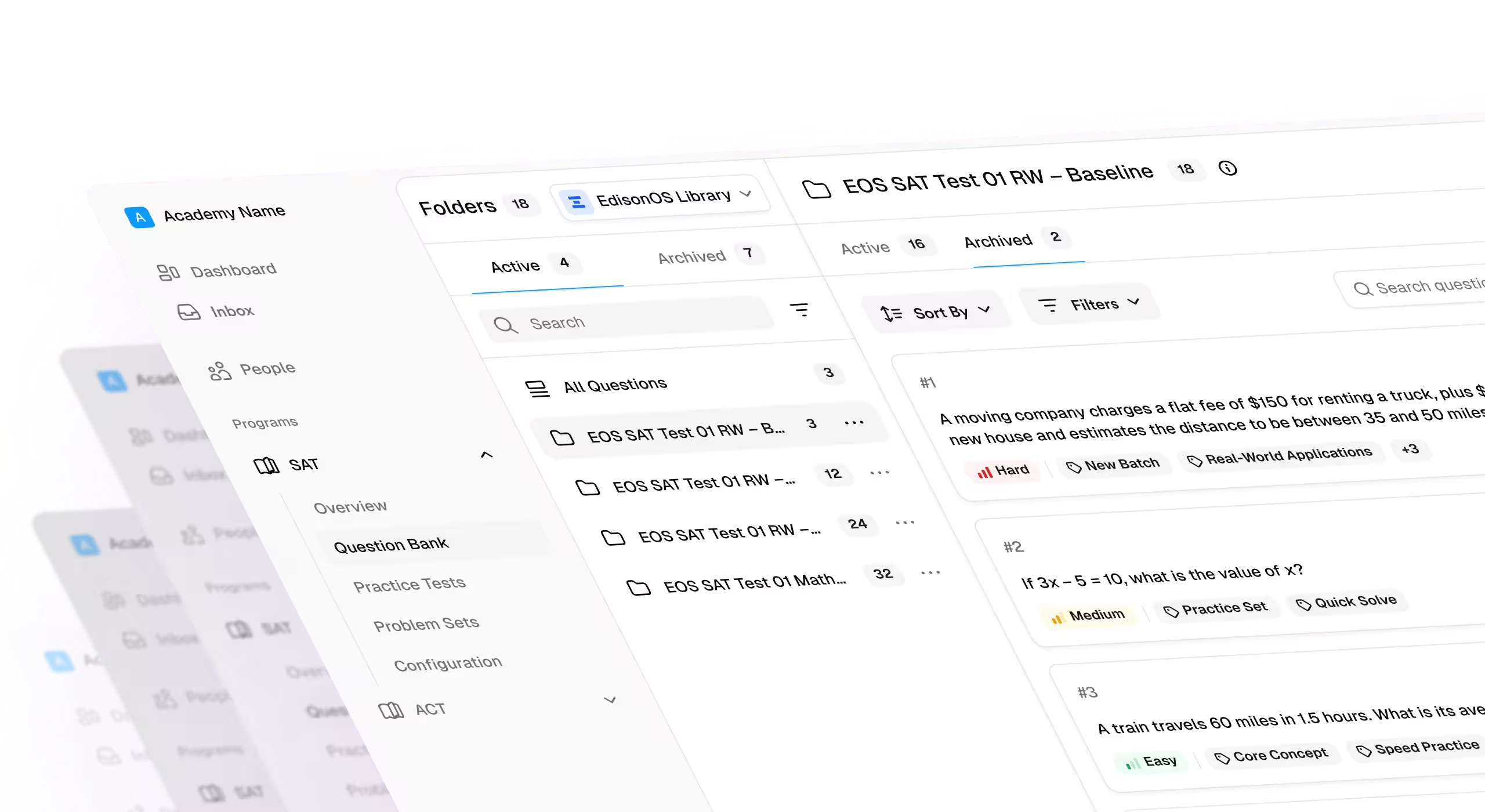
Pro Tip: Instead of reviewing every formula equally, focus more on weaker ACT Math topics. Some platforms, like EdisonOS, can help you identify low-accuracy areas through skill-level analytics, pacing reports, and full-length ACT practice tests. With it, you can target preparation and make it more strategic.
Time management: how to pace yourself through all 45 questions
Time management represents the defining factor between students who know the math and students who score well on the ACT Math section.
Yet, this average masks a critical reality—questions vary dramatically in complexity, and successful students must develop sophisticated pacing strategies that go far beyond simply "working faster."
Students frequently report knowing how to solve problems they never attempted, highlighting that time management failures directly translate to point losses. The psychological pressure compounds this challenge, as students who fall behind schedule often make careless errors on problems they could easily solve under normal conditions. Effective tutoring must transform time management from a source of anxiety into a strategic advantage.
Strategy 1: Master the strategic skip-and-return system
The most powerful time management technique involves recognizing when to abandon a problem temporarily rather than getting trapped in time-consuming struggles. This strategy prevents the cascade failure where one difficult problem destroys timing for the entire section.
The 30-second decision rule: If a student hasn't identified a clear solution path within 30 seconds, they should flag the question and move on. This threshold prevents students from spending 3-4 minutes on a single problem while easier questions remain unattempted.
Systematic flagging protocol:
- Circle the question number: Create a quick visual marker for return visits.
- Eliminate obvious wrong answers: Before moving on, cross out clearly incorrect choices to improve guessing odds.
- Make an educated guess immediately: Don't leave blanks—guess based on partial knowledge or elimination.
- Use consistent notation: Develop symbols for "definitely return," "maybe return," and "random guess."
Strategic return hierarchy: When returning to flagged questions, follow this priority system:
- First return pass (5-7 minutes remaining): Attack problems that seem solvable with fresh perspective.
- Second return pass (2-3 minutes remaining): Focus on questions where partial credit through elimination is possible.
- Final 30 seconds: Ensure no blanks remain—random guess if necessary.
This approach requires overcoming students' perfectionist tendencies and teaching them that strategic abandonment is a sign of mathematical maturity, not failure.
Strategy 2: Implement checkpoint-based pacing control
Rather than hoping students will naturally maintain appropriate pace, establish specific checkpoints that provide early warning when timing goes off track. This system allows for proactive adjustments before situations become critical.
Paper ACT checkpoint system
- Question 15 by 15 minutes: Early pace verification—should feel comfortable and confident.
- Question 30 by 30 minutes: Critical midpoint assessment—if behind, begin aggressive skipping.
- Question 45 by 45 minutes: Final sprint begins—focus on completion over perfection.
- All questions attempted by 55 minutes: Reserve 5 minutes for returns and final guessing.
Digital ACT checkpoint system
- Question 11 by 12 minutes: Early rhythm check.
- Question 22 by 25 minutes: Midpoint evaluation—adjust strategy if needed.
- Question 34 by 38 minutes: Approaching peak difficulty—maintain focus on completion.
- All questions attempted by 45 minutes: Use remaining time for strategic returns.
Checkpoint recovery strategies
When students fall behind checkpoints, teach these escalating responses:
- 1-2 questions behind: Slightly increase pace while maintaining accuracy.
- 3-4 questions behind: Begin skipping problems that require more than 90 seconds.
- 5+ questions behind: Switch to rapid elimination and educated guessing mode.
Regular checkpoint practice builds internal timing awareness and prevents the panic that occurs when students suddenly realize they're far behind schedule.
Strategy 3: Develop question-type time allocation skills
Not all ACT Math questions deserve equal time investment. Students must quickly categorize problems and allocate appropriate time based on complexity and point value.
Time value recognition training
Teach students to rapidly assess and categorize problems:
- 30-45 second problems: Basic arithmetic, simple linear equations, formula substitution, percentage calculations
- 60-75 second problems: Multi-step algebra, standard geometry applications, coordinate geometry basics
- 90-120 second problems: Complex word problems, trigonometry applications, system of equations
- 2+ minute problems: Multi-concept integration, advanced function analysis, proof-style reasoning
Visual complexity indicators
Students should learn to identify time-intensive problems immediately:
- Dense text blocks: Word problems requiring translation and setup time
- Multiple diagrams: Geometry problems requiring spatial reasoning and relationship analysis
- Unusual notation: Advanced concepts that may require additional thinking time
- Question position: Later questions (40+) typically require more sophisticated approaches
Strategic time banking
Strong students should aim to complete early questions in 45-50 seconds, "banking" extra time for challenging problems later. This requires:
- Pattern recognition: Instant identification of familiar problem types
- Formula automation: Immediate recall without conscious effort or hesitation
- Mental math fluency: Quick calculation techniques for common operations
- Estimation skills: Recognition when approximate answers are sufficient
This differentiated approach ensures students invest their limited time where it will yield the highest point returns.
Strategy 4: Perfect answer sheet and navigation efficiency
Time lost to mechanical processes like bubbling answers or navigating between questions can accumulate to several minutes over a full section. Developing efficient habits in these areas provides more time for actual problem-solving.
Strategic bubbling for paper tests
Rather than bubbling after each question (which costs 8-10 seconds per question), teach batching strategies:
- 5-question batches: Answer 5 consecutive questions, then bubble all responses together.
- Page-based bubbling: Complete all questions on a test booklet page, then transfer answers.
- Time-remaining bubbling: When 10 minutes remain, prioritize completing all bubbling.
- Verification protocol: Always check that question numbers align perfectly with answer sheet positions.
Digital navigation mastery
For the enhanced digital ACT, students must develop fluency with:
- One-click flagging: Instant marking of questions for return without disrupting rhythm
- Keyboard shortcuts: Efficient movement between questions using arrow keys or number navigation
- Answer modification: Quick techniques for changing responses without time loss
- Progress tracking: Using built-in indicators to monitor pacing without losing focus
Answer choice elimination techniques
Systematic elimination saves time and improves guessing accuracy:
- Digital tools: Use available highlighting or striking features to mark eliminated options
- Logical ordering: Always eliminate most obviously incorrect answers first
- Confidence notation: Mark final answers with confidence levels (certain/likely/guess) for return prioritization
These mechanical efficiencies compound throughout the test, potentially providing 3-5 additional minutes for problem-solving.
Strategy 5: Build pressure tolerance through progressive training
Time management skills developed under comfortable practice conditions often collapse under actual test pressure. Students need systematic exposure to increasingly challenging timing scenarios to build real performance capabilities.
Progressive pressure protocol
Structure practice with escalating time pressure:
- Week 1: Individual topic practice with 75-second time limits (below test pressure)
- Week 2: Mixed practice sections with 60-second average (at test pressure)
- Week 3: Full sections with 50-second average targets (above test pressure)
- Week 4: Full practice tests with environmental distractions (extreme pressure simulation)
Micro-session timing drills
Build timing reflexes through focused exercises:
- 5-question sprints: Complete 5 varied problems in exactly 4 minutes, 30 seconds.
- Accuracy-speed balance tracking: Record both correct answers and completion times.
- Stress inoculation training: Practice with background noise, time pressure announcements, and interruptions.
- Recovery simulation: Practice regaining composure and timing after making mistakes.
Psychological pressure management
Teach students to handle timing stress through:
- Breathing reset techniques: 3-second deep breath protocols to regain composure when timing pressure builds
- Positive self-talk scripts: "I can catch up" and "strategic guessing is smart" rather than "I'm failing"
- Focus redirection skills: Concentration on current problem rather than time deficit anxiety
- Strategic acceptance mindset: Recognition that sometimes educated guessing is the mathematically optimal choice
Full simulation requirements
Students should complete multiple full-length math sections under exact test conditions, including identical timing, answer sheets, environmental conditions, and time-of-day scheduling. This builds familiarity with sustained pressure and prevents test-day surprises.
Through systematic application of these five strategies, students develop time management as a competitive advantage rather than a source of anxiety, allowing their mathematical knowledge to translate directly into ACT score improvements.
A Quick Hack: The ACT Math Timing Table
The ACT Math section moves quickly, especially in the later questions, where problems become more complex and time-consuming. And since running out of time is one of the biggest challenges with the ACT Math section, having pacing checkpoints can help you stay aware of your progress during the test.
So, instead of trying to manage every question individually, follow these pacing checkpoints throughout the section.
12 ACT Math Tips and Tricks to Get High Marks
Here are 12 expert tips for ACT Math that tutors can use in sessions—and students can apply during prep and on test day—to cover everything from content mastery to pacing and confidence.
Tip 1: Understand the ACT Math format thoroughly
Scoring rules and strategy
Each correct answer earns exactly one point, regardless of question difficulty. Crucially, there is no penalty for guessing, meaning incorrect or blank responses don't subtract points from the total score. This scoring structure creates a clear strategic imperative: students should attempt every question, even if they must guess randomly.
The equal point value of all questions also means that spending excessive time on one difficult problem while leaving easier questions unanswered represents poor strategy.
Reducing test-day anxiety
Thorough familiarity with the test format prevents surprises that can derail performance and allows students to focus entirely on problem-solving rather than navigating unfamiliar procedures.
As a tutor, you should simulate the real testing interface during practice sessions, including on-screen calculator usage, question flagging systems, and digital navigation tools.
Students who practice under authentic conditions develop automatic responses to format-specific challenges, freeing mental resources for mathematical reasoning on test day.
Tip 2: Prioritize High-Weight Topics
Identify the big areas
Not all ACT Math topics carry equal weight, and strategic preparation requires understanding this distribution. Approximately half of the problems cover Algebra and approximately 40% cover geometry. The remaining 10% covers concepts from middle school and some problems over high school Pre-calculus.
Specifically, algebra topics (including pre-algebra, elementary, and intermediate algebra) comprise roughly 66% of all questions, making them the clear priority for preparation time.
Geometry (both planar and coordinate) accounts for the significant majority of remaining questions, while trigonometry typically appears in only about four questions per test.
Run a diagnostic assessment
Before diving into content review, have students complete a full Math section under authentic timed conditions to establish baseline performance. Analyze their results not just for overall accuracy, but for domain-specific patterns—do they consistently miss geometry problems while excelling in algebra, or vice versa?
This diagnostic data becomes the foundation for creating a personalized study plan that addresses actual weaknesses rather than perceived ones. Document specific error types within each domain, such as whether geometry mistakes stem from formula confusion, spatial reasoning difficulties, or calculation errors.
Front-load study on core content
Given the weight distribution, algebra fundamentals should receive primary attention in early tutoring sessions. Focus on solving linear and quadratic equations, factoring techniques, working with ratios and proportions, and manipulating algebraic expressions. For geometry, emphasize angle properties, triangle theorems (including special right triangles), and circle formulas.
Students must memorize and practice applying key formulas repeatedly until recall becomes automatic—the quadratic formula, area and perimeter calculations, slope formula, and distance formula appear frequently enough to justify intensive memorization efforts.
Allocate tutoring time by impact
Structure your tutoring schedule to reflect question frequency and individual student error patterns. If a student struggles with coordinate geometry (9 questions) but excels in trigonometry (4 questions), allocate proportionally more time to coordinate geometry review.
Spend extra sessions on topics that combine high question frequency with high error rates for maximum score improvement potential. Reserve lighter review sessions for low-frequency areas like advanced trigonometric identities or complex number operations, which rarely appear and offer limited return on time investment.
Maintain balanced coverage
While prioritizing high-impact areas, avoid completely neglecting any topic domain. Even low-frequency topics like trigonometry can provide crucial points for students aiming for top scores, and complete gaps in knowledge create unnecessary vulnerability.
The key is working smarter rather than harder—ensuring basic familiarity with every domain while investing concentrated effort where it moves the score needle most effectively. This balanced approach prevents students from being blindsided by unexpected question types while maximizing preparation efficiency across the full content spectrum.
Tip 3: Practice timed sections regularly
Real, timed practice represents the bridge between content knowledge and test performance under pressure. Students often excel in untimed practice sessions only to struggle when facing the actual time constraints of the ACT Math section. Regular timed drills offer four critical benefits that transform preparation from theoretical knowledge into practical test-taking ability.
Pacing mastery
Consistent timed practice builds an internal rhythm that helps students naturally gauge their progress throughout the section. Rather than constantly checking the clock and losing focus, students develop an intuitive sense of the one minute per question pace that characterizes successful ACT Math performance.
This internal timing mechanism allows for better self-regulation during the actual test, as students can sense when they're falling behind schedule and need to adjust their approach without the anxiety-inducing shock of discovering major time deficits late in the section.
Stamina and focus development
The ACT Math section demands sustained concentration and mathematical reasoning for a full hour (or 50 minutes on digital format). Students who practice only individual problems or short problem sets often experience mental fatigue and declining accuracy in the latter portion of the actual test.
Regular full-section practice builds the cognitive endurance necessary to maintain sharp focus and computational accuracy through all questions, preventing the score-damaging errors that commonly occur when mental energy flags toward the end of the section.
Pressure-proofed strategy implementation
Test-taking strategies that seem natural during relaxed practice often break down under time pressure and test anxiety. Timed practice sessions allow students to rehearse and refine their approach to answer elimination, educated guessing, and problem-solving shortcuts until these techniques become automatic responses rather than conscious decisions.
Students learn to trust their strategic training even when stress levels rise, ensuring that their preparation translates directly into test-day performance improvements.
Realistic performance benchmarking
Only timed practice with official-style questions provides accurate assessment of current ability and meaningful measurement of improvement over time. Untimed practice scores create false confidence, while timed practice reveals genuine strengths and weaknesses that require attention.
These realistic benchmarks allow tutors and students to track both speed and accuracy gains, adjust preparation strategies based on actual performance data, and set appropriate score goals grounded in demonstrated capability rather than wishful thinking.
Tip 4: Teach Students to Skip and Return Strategically
Top-performing students understand that ACT Math success depends not just on mathematical ability, but on intelligent question selection and time allocation.
Flag time sinks immediately
Students should develop a strict internal timer that triggers strategic abandonment when a question stalls their progress for approximately 30 seconds. This threshold prevents the common trap where students invest 3-4 minutes in a single difficult problem while leaving multiple easier questions unattempted.
The key is teaching students to recognize the difference between productive thinking time and unproductive struggle—if they haven't identified a clear solution path within 30 seconds, the question becomes a candidate for later return rather than continued immediate effort.
Value every question equally
Since every question is multiple choice, and there is no penalty for guessing, all problems carry identical point value regardless of difficulty level. Students must internalize this reality and resist the natural tendency to persist on challenging problems simply because they seem more significant.
Trading three easily solvable questions for one time-consuming difficult problem represents poor strategic thinking—the mathematics of scoring demands that students prioritize accessibility over complexity when time becomes a limiting factor.
Practice the routine systematically
Skip-and-return strategies only become effective through deliberate practice under timed conditions. Every practice session should include opportunities to flag questions, make strategic decisions about time allocation, and experience the process of returning to skipped problems with limited time remaining.
Students need to build comfort with the psychological challenge of leaving questions incomplete and develop confidence that this approach improves rather than harms their overall performance.
Tip 5: Focus on Reducing Careless Errors
Careless errors represent one of the most frustrating sources of point loss on the ACT Math section, as they typically occur on problems students understand conceptually but execute incorrectly due to rushed work or lack of systematic checking. Teaching students a quick, five-step accuracy checklist helps catch these costly mistakes before they become permanent score damage.
Stem review
Students should develop the habit of physically underlining or highlighting the specific question being asked, particularly the final phrase that indicates what value to find.
This simple step prevents the common error of solving for the wrong variable or quantity—for example, finding the radius when the question asks for diameter, or calculating the slope when the problem requests the y-intercept.
Taking two seconds to mark the target prevents minutes of accurate work that leads to an incorrect answer simply because the student solved for the wrong thing.
Sign and unit scan
Before beginning calculations, students should scan the problem for potential trouble spots including negative signs, unit specifications, and decimal placements.
Many errors stem from overlooking a negative sign in an equation, forgetting to convert between units (feet to inches, degrees to radians), or misplacing decimal points in calculations.
This brief scanning step helps students set up problems correctly from the start rather than discovering mistakes after completing lengthy calculations.
Scratch-pad clarity
Encourage students to rewrite complex problems neatly in their scratch space, numbering each step of their solution process.
Clear, organized work serves multiple purposes: it reduces computational errors that occur when work becomes messy and hard to follow, it makes checking work more efficient, and it helps students identify exactly where mistakes occurred if they need to revisit a problem.
The few seconds spent organizing work pays dividends in accuracy and error prevention.
Answer validation
Before bubbling their final answer, students should ask themselves whether their result makes sense in the context of the problem.
Does the calculated area seem reasonable for the given dimensions?
Is the percentage result between 0 and 100 where appropriate?
Does the answer actually address what the question asked for?
This sanity check catches many errors that occur when students correctly follow mathematical procedures but apply them to the wrong scenario or misinterpret the problem setup.
Strategic error catching
In the last 10 seconds of work on any problem, students should perform a quick visual scan of their calculation work, paying special attention to flagged items or complex multi-step problems where errors commonly occur.
This isn't a complete re-solution but rather a rapid check for obvious mistakes like sign errors, miscopied numbers, or calculation slips.
While time pressure makes extensive checking impossible, this brief final review catches many errors with minimal time investment and can be the difference between a good score and a great one.
Tip 6: Plug in the answers (PITA) to solve fast
Sometimes ACT Math questions are intentionally designed to look more complicated than they actually are. So, instead of spending valuable time setting up long algebraic equations, you can sometimes use the answer choices themselves to solve the problem faster.
This strategy is commonly called Plug In the Answers (PITA).
So, rather than solving from scratch, you test the answer choices directly to see which option satisfies the question.
The strategic use of the PITA technique can reduce calculation time, simplify messy algebra, and help you avoid getting stuck on difficult-looking problems.
When plugging in answers works best
Plugging in answers is especially effective on:
- percentage questions
- ratios and proportions
- algebraic equations
- word problems with numeric answer choices
- problems that would otherwise require lengthy calculations
For example, if a question asks for the value of a variable and all answer choices are numbers, then testing the choices directly can sometimes be faster than solving the equation traditionally.
Start with the middle answer choice
Whenever the answer choices are arranged from smallest to largest, instead of testing every option one by one, start with the middle choice first. If the middle value is too large, you can eliminate all wider choices. If it is too small, you can eliminate the smaller half immediately.
This simple adjustment can save valuable time, especially on harder questions later in the section, where pacing becomes more important.
Avoid overusing the strategy
While the PITA technique is useful, it should not replace straightforward solving methods.
Many students lose time testing every answer choice, even when the algebra is relatively simple. The goal is to recognize when plugging in is faster and avoid forcing the strategy on every question.
In general, PITA works best when:
- The answer choices are numeric
- The traditional setup looks time-consuming
- You are stuck between multiple approaches
But if the equation is simple and direct, solving it normally is usually faster.
The more you practice ACT-style questions under timed conditions, the easier it will become to recognize when strategies like PITA can save time and reduce unnecessary work.
Tip 7: Back-solve the difficult questions
Some ACT Math questions may look difficult because of the setup, even when the math itself isn’t especially difficult. In such cases, instead of trying to build the entire solution from scratch, you can work your way backward from the answer choices.
This strategy is called back-solving.
Rather than setting up long equations immediately, you test the answer choices to see which one logically satisfies the conditions in the question. This technique is especially useful under time pressure because it can simplify multi-step problems and reduce unnecessary calculations.
Know when to stop solving traditionally
One of the biggest ACT Math mistakes students make is spending too much time trying to solve difficult problems “the proper way,” even when the setup becomes complicated.
If you have already spent significant time building equations and still do not have a clear solving path, back-solving may be the faster option.
Back-solving is usually an efficient technique for:
- percentage problems
- ratio and proportion questions
- word problems
- multi-step algebra questions
- problems with numeric answer choices
For example, a question might ask for the final value after several operations. Here, testing the answer choices directly is often faster than building and solving a long equation from scratch.
Use answer choices to eliminate faster
Back-solving also helps students catch unreasonable answers early. We mentioned earlier that sometimes ACT answer choices are arranged in numerical order. Even here, you can often eliminate multiple options quickly by starting with the middle answer choice.
If the middle value is too high, eliminate wider choices immediately. If it is too low, rule out smaller values instead. This process helps narrow possibilities quickly without testing every single option.
If a value clearly does not meet the problem's conditions, you can move on without wasting additional time.
Tip 8: Using the plug-in numbers (PIN) technique
Some ACT Math problems are much easier once you replace abstract variables with real numbers you can actually work with.
This strategy is commonly called Plug In Numbers (PIN).
Instead of mentally reasoning through complex variable relationships, students assign simple values to the variables and solve the problem with actual numbers.
You’re not avoiding the math here. The goal is to simplify confusing algebra and make relationships easier to understand under time pressure.
When replacing variables works best
Replacing variables with numbers works particularly well when a question feels more confusing than difficult. It is especially useful on:
- abstract algebra questions
- proportions and ratios
- fractions with variables
- expression comparison problems
- questions with multiple variables but no actual values
For example, if a problem describes relationships between variables without giving concrete numbers, assigning easy values can help students visualize what the question is really asking.
Choose simple numbers strategically
Which numbers you choose will matter in this context. In most cases, it is best to use:
- small positive integers
- easy values like 2, 3, 5, or 10
- distinct numbers for different variables
Caution: Avoid automatically choosing 0 or 1 unless the question specifically allows it and the relationship still makes sense. These values can sometimes oversimplify the problem or accidentally eliminate important parts of the equation.
When you pick the right numbers, it will make calculations easier while preserving the relationships in the original problem.
Don’t memorize steps; instead, simplify
You’ll lose time if you memorize too many solving methods instead of focusing on understanding the relationships inside the problem. Replacing variables with numbers helps reduce mental overload because it turns an abstract expression into something more concrete and manageable.
This will come particularly handy during harder sections of the ACT Math test. Use this method when you see a long, variable-heavy question that creates panic or may slow you down unnecessarily.
Tip 9: Demystify word problems and multi-step questions
Word problems represent one of the most significant anxiety sources for ACT Math students, not because they lack mathematical knowledge, but because they struggle to extract mathematical relationships from dense verbal descriptions.
Read actively and translate mathematical language
Students should approach word problems as translation exercises rather than pure mathematical challenges, beginning by underlining or highlighting key numerical data, variable relationships, and the specific question being asked.
After this initial scan, require students to restate the problem in their own words, stripping away extraneous narrative details to reveal the core mathematical relationships. This translation process helps students differentiate between relevant information that drives the solution and decorative context that can distract from the essential mathematical task.
The act of restating also forces students to confirm their understanding before beginning calculations, preventing the common error of solving the wrong problem accurately.
Break complex problems into sequential steps
Multi-step word problems become manageable when students learn to decompose them into numbered, sequential tasks that build toward the final answer.
For example, a problem might require students to (1) find the area of a rectangle, (2) use that area to determine material costs, and (3) calculate total expenses including tax.
By explicitly numbering each step and solving one component at a time, students avoid the overwhelming feeling of facing an impossibly complex problem while also preventing cascading errors where mistakes in early calculations corrupt all subsequent work.
This methodical approach also makes checking work more straightforward, as students can verify each step independently.
Make abstract relationships visual
Encourage students to create simple sketches, diagrams, or organizational tables that transform verbal descriptions into visual representations of mathematical relationships.
Geometry word problems benefit from labeled shapes that show given measurements and unknown values, while rate problems become clearer when students draw timelines or distance diagrams. Even algebraic word problems often benefit from simple charts that organize given information and unknown variables.
These visual aids serve as external memory supports that reduce cognitive load while also helping students identify relationships that might not be apparent from text alone.
Identify the core mathematical concept
Behind every word problem lies a fundamental mathematical skill or concept that the problem is designed to assess. Train students to ask themselves, "What specific mathematical knowledge is this problem testing?" before beginning calculations.
Is this fundamentally a proportion problem disguised as a recipe scenario?
Does this distance/rate/time story problem require the basic formula d = rt?
Is this percentage problem hiding behind a sales tax context?
Identifying the underlying mathematical structure helps students select appropriate formulas and solution strategies while building confidence through recognition of familiar patterns.
Practice with reflection and pattern recognition
Use official ACT word problems during practice sessions, but extend beyond simple solution verification to include structured reflection on problem-solving approaches.
After solving each problem, discuss any misleading details, unnecessary information, or potential traps that might confuse students during actual testing. Help students recognize common word problem categories and the mathematical approaches they typically require.
With repeated practice and reflection, students develop pattern recognition skills that allow them to quickly categorize new word problems and apply appropriate solution strategies, transforming their attitude from "I hate word problems" to "Let me systematically break this down into manageable pieces."
Tip 10: Avoid careless mistakes
The ACT Math section rewards controlled speed, not rushed solving. So often, students lose points from preventable mistakes on easier questions than from the hardest problems on the test.
Avoiding careless mistakes will help you more than any act math tricks.
Most common ACT Math careless mistakes
Some careless mistakes recur across ACT Math practice tests, especially as students rush later in the section.
Common examples include:
- solving for the wrong value
- missing negative signs
- confusing radius and diameter
- copying numbers incorrectly
- calculator input mistakes
- forgetting unit conversions
- bubbling the wrong answer
- rushing through easier questions too quickly
These mistakes occur when you’re entirely focused on speed and stop checking whether the answer actually matches what the question is asking.
Tip: You can recognize these patterns early during your prep. Be mindful of types of mistakes you personally make under pressure, and work to fix them from the beginning.
First off, read what the question is actually asking
One of the fastest ways to lose points on ACT Math is answering a different question than the one being asked.
Students commonly misread and make these mistakes:
- Calculate the radius instead of the diameter
- Solve for x instead of x²
- Miss words like “NOT” or “EXCEPT”
- Ignore units or conversion requirements
So, before solving, take a few extra seconds to identify what the final target of the problem is.
You can underline key words or circle units on scratch paper to stay focused on the actual question (instead of rushing into calculations too quickly).
This is a small habit, but it becomes especially important during the later parts of the ACT Math section. Because towards the end, fatigue and pacing pressure both increase.
Slow down slightly on easier questions
Early questions on the ACT are usually more straightforward, which makes them valuable scoring opportunities. But most students assume they should move through early ACT Math questions as quickly as possible. And while pacing matters, rushing too much will cause mistakes on questions you could have answered correctly.
We’re not telling you to go slow. We’re telling you to avoid giving away easy points because of preventable errors.
The best way to study for ACT Math is to learn to balance speed with accuracy. Missing easy algebra, arithmetic, or geometry questions because of rushing will hurt scores more than struggling on a few difficult questions.
Tip 11: Use strategic guessing to keep your pace
You don’t need to solve every question perfectly. Strong ACT Math performance is about maximizing points within a limited amount of time.
On the ACT Math section, protecting your time is more valuable than solving one challenging question perfectly. And when a question is consuming too much time, strategic guessing is not giving up. It is making a smart decision before it affects the rest of the section.
Recognize time-trap questions early
If you have already spent significant time on a problem and still do not have a clear path to solving it, continuing to force a solution will hurt your pacing across the entire section. And some ACT Math questions are designed to slow students down with:
- long setup
- unfamiliar wording
- multiple variables
- complicated diagrams
- multi-step calculations
Recognize when a question is becoming a time trap and move on before losing several minutes unnecessarily.
This becomes especially important in the later part of the ACT Math section, where questions become more complex and the pressure to finish increases.
Use partial solving before guessing
Strategic guessing works best if you gather as much information as possible before moving on. So, instead of randomly selecting an answer, try to:
- Estimate a reasonable range
- Eliminate impossible values
- Identify positive or negative answers
- Compare answer choice sizes
- Simplify part of the problem first
Even partial solving can significantly improve the odds of choosing the correct answer. So, say if a geometry problem clearly requires a positive answer, you eliminate all negative values instead of treating every option equally.
Do not let one question control the rest of the section
Say you’ve already spent too much time on a difficult question. That’s ok, don’t become emotionally attached to it. Many students think:
“I’ve already invested this much time, so I have to finish it.”
But continuing to struggle with a single problem often leads to panic, which causes rushed mistakes. And let’s not forget to mention that you lose points on later questions.
Sometimes the smartest decision is making your best possible choice, moving forward confidently, and returning later if time remains. Focus on protecting the overall section score rather than winning every individual battle.
Tip 12: How to check your work
The last few minutes of the ACT Math section will either help protect your score or create unnecessary panic. Many students finish the section and immediately rush through random questions, change answers impulsively, or try to fully resolve problems under pressure.
Don’t do that. Instead, take a more strategic approach to review.
Your goal is to use the remaining time wisely to protect points and improve decision-making on uncertain questions.
First, prioritize flagged questions
Not every question deserves equal review time. Strong test-takers focus first on the answers most likely to contain mistakes.
If you have extra time remaining, start by reviewing:
- flagged questions
- educated guesses
- rushed problems
- questions you felt uncertain about
This targeted review approach will help you use your limited time more efficiently. It will also improve your chances of catching errors.
Use quick verification instead of full re-solving
You won’t have enough time to fully resolve every ACT Math question. Instead, focus on building a fast and efficient checking routine. Before moving on from every question, quickly verify:
- signs and negative values
- copied numbers
- calculator entries
- unit consistency
- whether the answer seems reasonable
For example, say a geometry question produces an unusually large or negative value when the answer should logically be small and positive. It’s often a sign that something went wrong during setup or calculation.
You can also use fast verification methods like:
- plugging your answer back into the question
- estimating whether the answer makes sense
- checking setup logic quickly
- reviewing important calculation steps
While these quick checks take only a few seconds, they can prevent avoidable score drops.
Caution: Don’t change answers without a clear reason
One of the biggest mistakes students make during review is changing correct answers out of panic or self-doubt.
Even if you’ve spent days and months practicing hard for ACT math, you’ll feel the pressure once the timer gets low. And most students, they often begin second-guessing themselves in this situation.
This is why, unless you discover a clear calculation error, logic mistake, or misread question, trust your original reasoning. Changing answers impulsively in the final minutes often creates new mistakes rather than improving scores.
Lastly, finish the section calmly, not frantically
Staying controlled under pressure, especially near the end of the section, is the name of this game. Students who panic during the final minutes often:
- rush calculations
- overthink familiar questions
- lose focus
- waste time jumping between problems
So, instead of treating the final minutes as a race, use them to make calm and intentional decisions. A structured review process will help you finish with better focus and more confidence.
Should I guess on the ACT Math?
Yes. If you are unsure about an ACT Math question, you should still make a guess instead of leaving it blank.
The ACT does not penalize students for wrong answers, which means there is no advantage to skipping a question entirely. Even a random guess gives you a chance of earning points, while a blank answer guarantees zero points.
That said, strategic guessing works better than random guessing.
If you get stuck on a difficult question:
- eliminate obviously wrong answers first
- make your best possible guess
- flag the question if time allows
- move forward instead of getting trapped on one problem
Many students lose valuable time trying to solve a single hard question perfectly. So, these pacing strategies matter just as much as (if not more) any other ACT math section tips. Spending three or four minutes on one question can hurt your performance across the rest of the section.
Strong ACT Math strategies focus on protecting time and maximizing scoring opportunities across all 45 questions. Practicing under realistic timed conditions can help students recognize when to solve fully, when to skip temporarily, and when to make an educated guess.
Pro Tip: Using free timed practice tests and pacing analytics can also help students identify where they consistently lose time during ACT Math sections.
How To Improve ACT Math Score: A Targeted Study Plan
Improving your ACT Math score is less about learning completely new math concepts and more about identifying the patterns that consistently lower your performance.
Many students spend months practicing without improving because they study everything equally. What you need to do instead is focus on the areas that most affect your score.
A more strategic study plan can help you improve your math score faster while using your practice time more efficiently. Here’s how to do it:
- Identify your highest-impact weak areas first: Focus on topics that appear frequently on the ACT and consistently lower your score, such as algebra, functions, geometry, or timing-heavy word problems.
- Practice under realistic ACT timing conditions: Timed practice improves pacing, decision-making, and mental endurance. Practicing untimed for too long can create a false sense of confidence before test day.
- Review mistakes for patterns, not just correct answers: Pay attention to recurring issues like rushing, misreading questions, sign mistakes, or spending too much time on difficult problems.
- Focus on consistency before perfection: Improving accuracy on medium-difficulty questions usually increases ACT Math scores faster than obsessing over the hardest problems on the section.
- Track your progress over time: Score improvement becomes easier when you can clearly see which topics are improving and which still need work.
Pro Tip: With EdisonOS, you can take full-length ACT practice tests and use skill-level analytics, pacing reports, and topic-specific performance tracking to prepare more strategically for the test day.
Instead of guessing what to study next, you can use detailed insights to focus on the concepts and timing issues that have the biggest impact on your scores. With detailed Reporting & Analytics and BYOT (Build Your Own Test) capabilities, you can identify weak areas and create focused practice tests.
Ready to build smarter ACT prep strategies based on real performance data? Book a free demo to discover how EdisonOS can streamline your ACT Math prep and drive better results.